martedì 10 febbraio 2026
Gwendolen Mary "Gwen" Raverat [English wood engraver, 1885 – 1957]
Gwen Raverat
Il frontespizio che disegnò per la bibliografia di Sir Thomas Browne di Geoffrey
Keynes del 1910, che mostra la Morte che guida la mano dell'autore di "Urn Burial".
Etichette:
1900(prima metà),
illustrazioni e drawing
Peder Severin Krøyer [Norwegian-born Danish Painter, 1851-1909]
Peder Severin Krøyer - Roses (1893)
(Marie Krøyer seduta sulla sedia a sdraio nel giardino della casa di Mrs Bendsen)
Giorgio Vasari [Pittore, architetto e storico dell'arte italiano, 1511 – 1574] / Guido Cavalcanti
Giorgio Vasari - Sei poeti toscani (dettaglio di Guido Cavalcanti)(1544)
Olio su tavola - 132,8 × 131,1 cm - Minneapolis Institute of Art
.
Perchè non furo a me gli occhi dispenti
da: "Rime"
: : Guido Cavalcanti : :

Perchè non furo a me gli occhi dispenti
o tolti sì, che da la lor veduta
non fosse ne la mente mia venuta
a dire: — ascolta se nel cor mi senti? —
Una paura di novi tormenti
m’aparve allor sì crudele ed acuta
che l’anima chiamò: — donna, or ci aiuta
che li occhi ed io non rimagnan dolenti.
Tu gli ài fasciati sì, che venne amore
a pianger sovr'a lor pietosamente
tanto, che ’l sente una profonda voce,
la quale dice: — chi gran pena sente
guardi costui e vedrà lo su’ core;
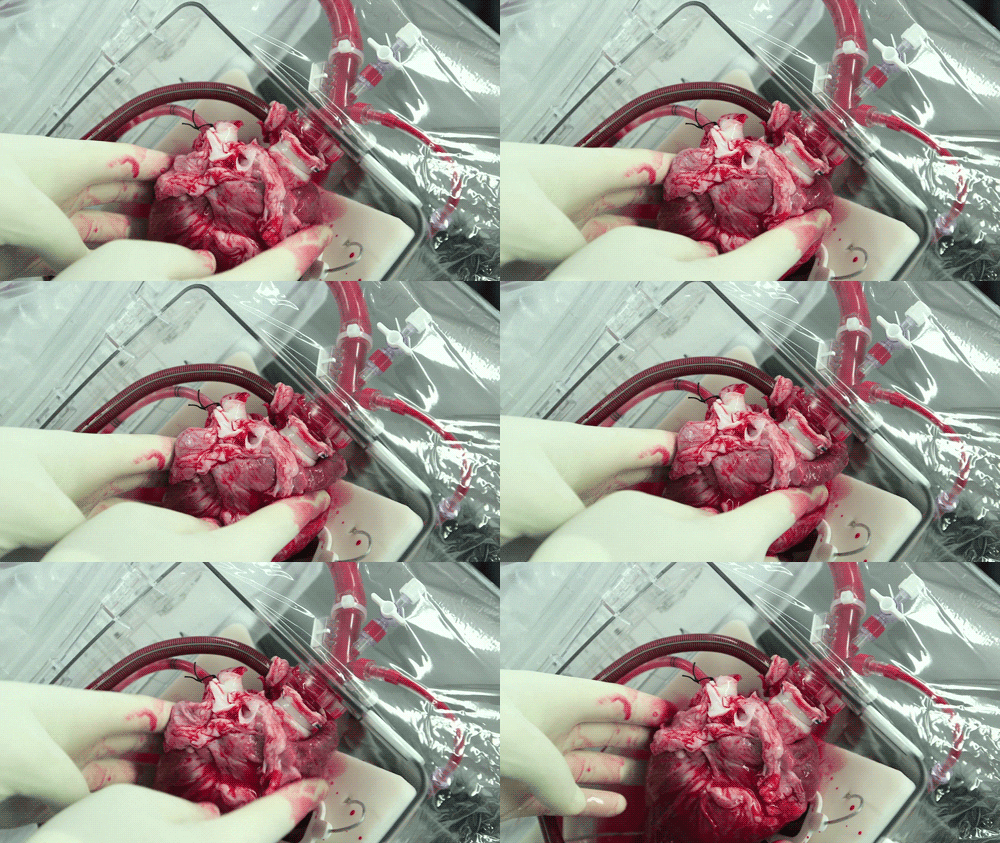
chè Morte ’l porta in man tagliato in croce. —
In Perchè non furo a me gli occhi dispenti, Guido Cavalcanti ci descrive cosa prova nel momento in cui ricorda la donna amata. La visita dell'immagine della donna semina nel poeta una tale disordine che egli maledice la vista e invoca la cecità.
Amore, eccezionalmente chiamato in causa nelle vesti di dio pietoso, cede il posto a Morte, che esibisce il cuore del poeta come un macabro trofeo.
Perché gli occhi non mi sono stati
spenti o strappati, così che, attraverso
la loro vista, [la donna] non fosse
venuta nella mia mente a dire:
«Ascolta se mi senti nel tuo cuore»?
Ché allora una paura di tormenti
inauditi mi colse, così spietata
e acuta che la mia anima gridò:
«Donna, ora aiutaci, affinché
gli occhi ed io non ne soffriamo.»
Tu li hai lasciati in tale condizione
che Amore è venuto a piangere
su di essi per compassione,
tanto che si sente una voce profonda
che dice: - Chi è addolorato guardi
costui [il poeta], e vedrà che Morte
porta il suo cuore tagliato in croce.
Giorgio Vasari [Pittore, architetto e storico dell'arte italiano, 1511 – 1574]
Giorgio Vasari - Sei poeti toscani (1544)
Olio su tavola - 132,8 × 131,1 cm - Minneapolis Institute of Art
.
Persone ritratte
Guittone d'Arezzo
Cino da Pistoia
Giovanni Boccaccio
Francesco Petrarca
Dante Alighieri
Guido Cavalcanti
Pieter Bruegel the Elder [Flemish Northern Renaissance Painter, ca.1525-1569]
Pieter Bruegel the Elder - Netherlandish Proverbs (1559)(detail)
"De kat de bel aanbinden"
(Suona il campanello del gatto)
Intraprendere qualcosa in modo appariscente
"Tot de tanden bewapend"
(Armato fino ai denti)
Pesantemente armati
"In het harnas steken"
(Mettere l'imbracatura)
Essere arrabbiato. Si riferisce all'atto figurato di indossare un'armatura per
andare in battaglia, spesso provocato da uno stato di rabbia o indignazione.
Etichette:
1500,
4 gatti,
aforismi.citazioni.proverbi,
Netherlandish Proverbs
Graham Annable [Fumettista e animatore canadese, b. 1970]
(Anche dopo tutti questi anni, lui aveva ancora occhi solo per lei.)
Etichette:
Graham Annable,
illustrazioni e drawing
John Atkinson Grimshaw / Alfred Tennyson
.
The Lady of Shalott
: : Alfred Tennyson : :

Part I
On either side the river lie
Long fields of barley and of rye,
That clothe the wold and meet the sky;
And through the field the road runs by
To many-towered Camelot;
And up and down the people go,
Gazing where the lilies blow
Round an island there below,
The island of Shalott.
Willows whiten, aspens quiver,
Little breezes dusk and shiver
Through the wave that runs for ever
By the island in the river
Flowing down to Camelot.
Four grey walls, and four grey towers,
Overlook a space of flowers,
And the silent isle imbowers
The Lady of Shalott.
By the margin, willow-veiled,
Slide the heavy barges trailed
By slow horses; and unhailed
The shallop flitteth silken-sailed
Skimming down to Camelot:
But who hath seen her wave her hand?
Or at the casement seen her stand?
Or is she known in all the land,
The Lady of Shalott?
Only reapers, reaping early
In among the bearded barley,
Hear a song that echoes cheerly
From the river winding clearly,
Down to towered Camelot:
And by the moon the reaper weary,
Piling sheaves in uplands airy,
Listening, whispers "'Tis the fairy
Lady of Shalott."
Part II
There she weaves by night and day
A magic web with colours gay.
She has heard a whisper say,
A curse is on her if she stay
To look down to Camelot.
She knows not what the curse may be,
And so she weaveth steadily,
And little other care hath she,
The Lady of Shalott.
And moving through a mirror clear
That hangs before her all the year,
Shadows of the world appear.
There she sees the highway near
Winding down to Camelot:
There the river eddy whirls,
And there the surly village-churls,
And the red cloaks of market girls,
Pass onward from Shalott.
Sometimes a troop of damsels glad,
An abbot on an ambling pad,
Sometimes a curly shepherd-lad,
Or long-haired page in crimson clad,
Goes by to towered Camelot;
And sometimes through the mirror blue
The knights come riding two and two:
She hath no loyal knight and true,
The Lady of Shalott.
But in her web she still delights
To weave the mirror's magic sights,
For often through the silent nights
A funeral, with plumes and lights
And music, went to Camelot:
Or when the moon was overhead,
Came two young lovers lately wed;
"I am half sick of shadows," said
The Lady of Shalott.
Part III
A bow-shot from her bower-eaves,
He rode between the barley-sheaves,
The sun came dazzling through the leaves,
And flamed upon the brazen greaves
Of bold Sir Lancelot.
A red-cross knight for ever kneeled
To a lady in his shield,
That sparkled on the yellow field,
Beside remote Shalott.
The gemmy bridle glittered free,
Like to some branch of stars we see
Hung in the golden Galaxy.
The bridle bells rang merrily
As he rode down to Camelot:
And from his blazoned baldric slung
A mighty silver bugle hung,
And as he rode his armour rung,
Beside remote Shalott.
All in the blue unclouded weather
Thick-jewelled shone the saddle-leather,
The helmet and the helmet-feather
Burned like one burning flame together,
As he rode down to Camelot.
As often through the purple night,
Below the starry clusters bright,
Some bearded meteor, trailing light,
Moves over still Shalott.
His broad clear brow in sunlight glowed;
On burnished hooves his war-horse trode;
From underneath his helmet flowed
His coal-black curls as on he rode,
As he rode down to Camelot.
From the bank and from the river
He flashed into the crystal mirror,
"Tirra lirra," by the river
Sang Sir Lancelot.
She left the web, she left the loom,
She made three paces through the room,
She saw the water-lily bloom,
She saw the helmet and the plume,
She looked down to Camelot.
Out flew the web and floated wide;
The mirror cracked from side to side;
"The curse is come upon me," cried
The Lady of Shalott.
Part IV
In the stormy east-wind straining,
The pale yellow woods were waning,
The broad stream in his banks complaining,
Heavily the low sky raining
Over towered Camelot;
Down she came and found a boat
Beneath a willow left afloat,
And round about the prow she wrote
The Lady of Shalott.
And down the river's dim expanse,
Like some bold seër in a trance
Seeing all his own mischance--
With a glassy countenance
Did she look to Camelot.
And at the closing of the day
She loosed the chain, and down she lay;
The broad stream bore her far away,
The Lady of Shalott.
Lying, robed in snowy white
That loosely flew to left and right--
The leaves upon her falling light--
Through the noises of the night
She floated down to Camelot:
And as the boat-head wound along
The willowy hills and fields among,
They heard her singing her last song,
The Lady of Shalott.
Heard a carol, mournful, holy,
Chanted loudly, chanted lowly,
Till her blood was frozen slowly,
And her eyes were darkened wholly,
Turned to towered Camelot.
For ere she reached upon the tide
The first house by the water-side,
Singing in her song she died,
The Lady of Shalott.
Under tower and balcony,
By garden-wall and gallery,
A gleaming shape she floated by,
Dead-pale between the houses high,
Silent into Camelot.
Out upon the wharfs they came,
Knight and burgher, lord and dame,
And round the prow they read her name,
The Lady of Shalott.
Who is this? and what is here?
And in the lighted palace near
Died the sound of royal cheer;
And they crossed themselves for fear,
All the knights at Camelot:
But Lancelot mused a little space;
He said, "She has a lovely face;
God in his mercy lend her grace,
The Lady of Shalott."
Michelangelo Buonarroti / Jean Louis Potrelle
Jean Louis Potrelle - Michelangelo
dal suo autoritratto del ca. 1530
"Assai acquista chi perdendo impara."
: : Michelangelo Buonarroti : :



Etichette:
1800,
aforismi.citazioni.proverbi,
illustrazioni e drawing
Atkinson Grimshaw [English Painter, 1836-1893]
John Atkinson Grimshaw - The Lady of Shalott (ca. 1875)
Oil on canvas - 610 - 914 mm - Yale Center for British Art, New Haven, Connecticut, USA
Mary Louise Brooks [Attrice e ballerina statunitense, attiva tra il 1923 e il 1938 - 1906-1985]
Tagebuch einer Verlorenen (Diario di una donna perduta) è un film del 1929
diretto da Georg Wilhelm Pabst, interpretato dalla famosa attrice Louise Brooks.
È considerato dalla critica uno dei capolavori del muto.
Etichette:
1900(prima metà),
cinema,
movida,
personaggi
Michelangelo Buonarroti
Michelangelo Buonarroti • Ragazzo accovacciato (1524)
Scultura, Marmo - 54 cm - Il Museo Statale Ermitage, Saint Petersburg
Andrea del Sarto [Italian High Renaissance Painter, 1486-1530]
Andrea del Sarto - L'ultima cena (1520-25)
Affresco - 525 x 871 cm - Museo del Cenacolo di Andrea del Sarto, Firenze
Richard Dagley [English subject painter and illustrator, ca.1761–1841]
Richard Dagley - The Gamester (1827)
Lo scheletro della Morte e il giocatore
dal libro: "Death's Doings" ("Le azioni della Morte")
Un giocatore è seduto a un tavolo con una tazza e dei dadi, mentre la Morte entra con delle pergamene legali che recitano "Assegnazione di proprietà e successioni implicano" e una
tazza per coprire i dadi. Lo scheletro indossa un berretto di piume, un mantello e una tunica.
Etichette:
1800,
Death's Doings,
illustrazioni e drawing
“L'ariano rinunciò alla purezza del sangue: e così perse il proprio posto nel paradiso che si era creato.” (Adolf Hitler, Mein Kampf)
In realtà l'immagine mostra un momento di una cerimonia di cambio della guardia presso l'Anıtkabir, il mausoleo di Mustafa Kemal Atatürk. L'Anıtkabir è situato ad Ankara, Turchia, ed è il luogo di sepoltura del fondatore e primo presidente della Repubblica di Turchia, Mustafa Kemal Atatürk.
lunedì 9 febbraio 2026
Camille Pissarro [French, 1830-1903]
Camille Pissarro - View from the Artist’s Window, Eragny (1885)
Oil on canvas - 54.5 x 65.1 cm
Museum of Fine Arts Boston, MA, USA
Paul Gauguin [French, 1848-1903]
Paul Gauguin - Haere Pape (Toilette mattutina)(1892)
Oil on canvas - 91.2 x 66.4 cm - Barnes Foundation, Merion, PA, USA
William Blair Bruce [Canadian, 1859-1906]
William Blair Bruce - The Phantom Hunter (1888)
Oil on canvas - 151.1 x 192.1 cm
Art Gallery of Hamilton, Ontario, Canada
Josep Vergara [Spanish, 1726-1799]
Josep Vergara - Cain and Abel (2nd half of 18th century)
Oil on canvas - 42 x 34 cm - Museu de Belles Arts de València, Spain
James Arthur Baldwin [Scrittore statunitense, 1924 – 1987] / Pamhandle Slim
"Possiamo non essere d'accordo e amarci comunque,
a meno che il vostro disaccordo non sia radicato nella mia oppressione
e nella negazione della mia umanità e del mio diritto di esistere."
: : James Baldwin : :
Iscriviti a:
Commenti (Atom)


.jpg)
.jpg)
.jpg)

.jpg)
.jpg)